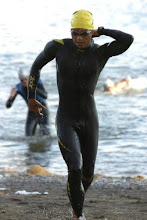
My second cycle of volume week went by quietly, unscathed of dramatic tweets. I found myself doing more and thinking less. I actually found myself excited and looking forward to some of the bigger training sessions, rather than dreading it. I've always thought the more fit you are, the less training drama, it's sort of an extension of this race rule: if you are feeling emotional, eat more! But as fit as I'm feeling, two mysteries still perplexed me this past week.
I feel like I'm just surviving the long/steep climbs where I used to feel like I attacked them. I'm doing the same long rides I used to do, but unlike the past where I would attack the climbs, I'm just barely surviving them, and on some days, not even surviving.
The second mystery involves my swimming. I've somehow lost my swim. There have been a couple of days where I've been able to find it, holding 1:10's until the cows come home; but for the most part, I feel like a slug through the water barely able to hold 1:15's. I've been a swimmer most of my life, and I can't remember having so many back-to-back days where I have no feel for the water.
Though both mysteries are a bit perplexing, I'm confident that they will sort themselves as I continue to train and get more fit. Though I spent nearly 20 hours training this week, I somehow failed to take any pictures, so I'm including a GOPro shot from a couple of weeks ago, where I did have my swim groove doing a long course workout.
When I first started racing triathlons, I was a poor cyclist, and I always looked forward to the run. I would get off the bike and try to chase down as many guys as I could, no matter how much it hurt. I am amazed at the level of hurt I could sustain on the run. I totally embraced it. When I watch strong runners like Craig Alexander, Kelly Williamson, and Mirinda Carfrae race, I totally see their willingness to suffer on the run to catch anyone and everyone. They too totally embrace it, knowing it's their weapon, and they gladly put themselves in the hurt box.
But as my cycling improved, my attitude toward the run somehow changed. I no longer attacked the run like I used to, and instead, I would run safe or tentative, trying to maintain my position, rather than working to improve my place. And I just couldn't dip as deep into the well. For some reason, almost every run I've done in the past two weeks, my thoughts go to this place.
My goal at last weekend's race was to take a step toward trying to change my current run attitude to more of what is used to be back in the day. I think I was successful for the first 2.5 miles, but after, I reverted back to my tentative, play-it-safe attitude. I couldn't sustain the "attack" attitude, but it was a step in the right direction. I signed up for a half-mary in a month's time, and my training will include taking more steps toward regaining my run attitude.
I'll leave you with a swim set that makes 1000 yards go by awfully fast. Swim a 1000 broken down as: 50 all out, 50 recovery, 100 fast, 100 moderate, 200 strong, 200 moderate, 100 fast, 100 moderate, 50 all out, 50 recovery. Pop your head up and site at each distance and get your splits. Pull one round and swim one round.
I was swimming the other day, and as is often the case when I'm doing a long distance set, my mind began to wander. Because I was focusing on a smooth hand entry, I thought about a demo I used to do when I was a middle school science teacher. I used this demo involving corn starch and water to demonstrate an exception to solids and liquids. Watch the above video and see if you can make the connection as to why this demo popped in my head as I was swimming and working on a smooth hand entry.
Corn starch mixed with water produces a dilatant, which is basically a liquid with properties of a solid or vice versa. The more force you exert on the dilatant, the more viscous (or more solid) it is. If you slap the dilatant, it will take on the properties of a solid, but if you ease your hands into the dilatant, it is liquid. Let's tie this back to the hand entry in swimming.
One of the foundations of a good swim stroke is proper hand entry. Some coaches call it "clean" but I think smooth best describes what I mean by proper hand entry. A smooth hand entry implies little to no splash, because you are placing your hand into the water. A proper hand entry will not only make the rest of the pull more efficient, it will prevent you from getting that stuck or pause in the stroke feeling often occurring when you increase your stroke rate.
Inexperienced swimmers, when trying to mimic the fast stroke rate of more experience swimmers, usually end up throwing their hand, and slapping the water on the entry. And recall what happens when you slap a dilatant. And this is why the demo popped in my head as I was swimming and focusing on a smooth hand entry.
If you want to improve your hand entry, start slow. Swim slow and focus solely on being precise with the hand entry, think of it as sneaking your hands into the water. As your precision improves, you can slowly increase the speed or stroke rate. Over time, you will be able to increase your stroke rate but still keep the precision, and soon enough, you will be just like those crazy fast ITU swimmers who look like they are throwing their arms wildly around but they are actually placing their hands in the water...really really fast!
As I was preparing for my swim workout on Saturday, I found myself falling back into the old routine of training to train. The day before, I swam 5000 yards with the main set consisting of 3 x 1000's, negative splitting the 500's. I certainly did not need another long, aerobic swim set but that was where my mind was going on Saturday. It then dawned on me that I needed to break this bad habit of training to train, but instead, train to race. And just like that, I came up with a more race specific swim workout:
Warm-up: straight 800 broken down as 400 free, 200 back, 200 reverse IM
Straight 700 flutter kick broken down as 25 FAST, 75 moderate; 50 FAST, 50 mod; 75 FAST, 25 mod; 100 FAST, 300 hold best pace
4 x [3 x 50 @ :50] -1. 12.5 yards ALL OUT off each wall -2. Middle 25 yards ALL OUT -3. Last 25 yards ALL OUT
4 x [5 x 100 Free @ 1:30, 1:25, 1:20, 1:15, 1:10 no extra rest in between rounds] -Rounds 1 & 2 swim -Rounds 3 & 4 pull [buoy, band, paddles]
Warm-down: 300 perfect freestyle technique
Total: 4400 yards
Like all of you, I spent the rest of Saturday glued to my computer watching the amazing performances at IM Melbourne, and then followed it up with the Mooloolaba World Cup race.
I wasn't too happy with the swim times in my last two races. The slow time in the first race was understandable: I didn't do the required intensity. But in between the first and second race, not only did I do more yardage, but I did more intensity, only to be disappointed again because of a slow time. I think the slow time was a result of poor swimming rather than slow swimming. I didn't site often enough and I didn't pay enough attention to try to swim the smartest/shortest line. I swam fast, it's just I swam fast over a longer distance, thus resulting in slower time. Also, I did not have the good fortune of having feet to draft, instead, I pulled a pack of swimmers the entire time. Open water is tricky that way. A fast swim time is rarely produced from speed alone, but rather a combination of speed, proper sighting to take the best/shortest line, getting a good draft, and water conditions. I have no control over water conditions, but I certainly will be more diligent about proper sighting, and finding a good draft in my next race. And I can't wait to get more open water swimming practice when I'm in Kona in July, because to get fast in the open water, you really have to swim in the open water (something I don't do here in the 50° water of the SF Bay).
Before I update you, I just want to say my last post on test taking was meant to be a humorous anecdote. Yes, I'm a bit frustrated but really, I was seeing the humor in it all when I posted that day. I guess sarcasm is mostly delivered in tone and can get lost in writing, but thanks to all of you who sent me encouraging emails. Alright, onto the wide pull update.
After three plus weeks of playing around with the wide pull, I've come to the conclusion that it's not the first pull I utilize when I start a swim workout; but it usually is a pull I end up utilizing at some point in the workout. In other words, when I start a set, I go with the pull that I'm accustomed to doing. As I start to experience fatigue, and I'm trying to maintain my pace or hold the interval, I find myself going to the wide pull--it's kind of like my emergency stroke. I just find this pull more efficient and easier to execute when I'm experiencing fatigue. I treat the wide pull as one more arsenal in my list of swim tactics such as: strong kick, fast turnover, distance per stroke, and body rotation. I'm attaching a series of videos with Karlyn Pipes-Neilsen that are quite informative. She really does a good job of explaining stroke mechanics, and even better, she has videos of her stroke and it really is amazing to watch her swim.
And one last noteworthy news. The DNF from Wildflower is already serving me well. This morning, I finally nailed this workout on the trainer that has eluded me the past four months. Close to my breaking point, I thought about my DNF and it got me up and over the hump that in previous tries, I was unable to do. Onward and upward.
I've been trying something slightly different with my swim stroke for the past two weeks, and I'm happy to report that the change is netting me faster times, and an improved efficiency. In fact, I felt faster almost immediately but like a good scientist, I wanted a larger sample size before I reported my findings. What is this change? I've been taking a wider pull.
Back in May when I was in Kona, I was doing an open water swim sesh with Bree, and we got to talking a bit about swimming. At some point, she told me that Karlyn (Pipes-Neilsen), an amazingly fast masters swimmer who qualified for the Olympic Trials as a 40 year-old, was preaching a wide pull (where the hands pull down and back along the side of the body rather than underneath). For some reason, two weeks ago, this bit of advice came back to me and I started to try a wider pull. Not only did I feel faster, but I felt more efficient, almost like a delayed onset of muscle fatigue. Now, when I say faster, I mean my pace for distance sets. Last night, I was holding 32's on the 40 second interval, and it felt so much more effortless than in the past. I'm not sure how this wide pull would hold up in the sprints, but I suspect it is less effective because there is less lift in the water with the wide pull. Since I've only been doing the wide pull for two weeks, I have no idea what, if any effects, there will be on biomechanics that may result in shoulder or other injuries. I like the result thus far and I plan to use the wide pull in my olympic distance race tomorrow. Will keep y'all posted.
I don't really do swim drills, I just try to swim with the most correct swim stroke all the time. I only have so much time in the water and rather than breaking down my workout to warm-up, drill set, pre-main set, main-set, drill set, cool-down, I just try to combine it all into one or two really really big sets. Once per week, I go to a masters workout and get all of that. Lately, I've been looking for bubbles when I swim. Bubbles equate to trapped air in the water. And if you have trapped air between your hands and the water, well, that's less water when you are pulling. Every now and then when I'm swimming, I'll pop my head up or move my head around to follow my stroke, and I look for bubbles. I need to improve my left arm, specifically during the breathing cycle. Now I just need to rotate just a tad more, finish my stroke a bit more, and stop moving my head up and down (something I've been doing since I was 12). I'm including a link to a video analysis of Jodie Swallow's swim stroke, it's good stuff!
I thought I would close out 2010 with a story to inspire y'all for the upcoming race season. Charisa just completed her debut season as a pro, and she is itching to start her second year racing with the big girls. A major goal Charisa had all season long was to break the one hour barrier for the ironman swim. She was hovering between 1:03-1:06 all season long. How am I qualified to tell Charisa's story? As a swim coach, every now and then I get triathletes who ask me for swim advice. In early October, Charisa came a knockin'. If you look at Charisa's swim stroke, she looks pretty damn good for someone without a swimming background. She rides really high in the water, she has good rotation, great posture, good head position, and her pull is adequately sufficient. Mind you, I'm looking at Charisa's stroke in the context of open water swimming and specifically triathlon swimming. If she wants to be a swimmer only and race in the pool, then yes, we would have to get picky and work on the little things about her stroke, because pool races are won in seconds or less. But because Charisa is a triathlete and most of her swimming is done wearing a wetsuit, we don't have to get picky. Time is better served working on other things.
As triathletes, there is so much out there in the way of training. Between TRX, yoga, dynamic stretching, Pilates, weights, swimming, biking, and running, and so on, we just don't have the time to do everything that is "supposedly" good for us. We need to be critical and choose what we as individual athletes need most to get fast. In the case of Charisa, I advised the following:
• Her stroke is more than adequate for triathlon swimming, don't do stroke work other than during warm-up or warm-down.
• Hit the weight room to gain more swim-specific muscles in the shoulders, back, and hips. Her stroke looks fine, it just isn't strong. She lacks functional swim strength.
• Kick! Real swimmers kick, even when they are not trying to, it's just ingrained in them from all those years of swimming. And if you are female, even more important. If you don't believe me, swim behind Bree Wee or Teresa Nelson, two very strong swimmers. Standing only 5'6", I guess you could say I have the frame of a woman. I learned the value of kicking during my age-group swimming years. All of my guy friends would grow to like six feet tall, big hands and big feet, and then there was me, stuck at 5'5". The cool thing about swimming is that boys and girls can train together. I noticed that the girls always kept up because their kicks were always so much faster than the boys. Thus, I too relied on my kick to keep up with my six feet competition. That and doing events that nobody wanted to do like the 200 fly and the 400 IM (watch a pool meet and notice how short the guys are in these two events). Sorry, tangent, where were we? Oh yea, I told Charisa that the philosophy is not to make her swim all about kicking, but about making her legs strong enough that after 2.4 miles of swimming, her legs and hips are not fatigued and feel fresh.
• Do ironman swim-specific workouts. Such workouts focus on efficiency and maintaining a fast stroke rate, which is very important in open water swimming. I gave Charisa my bread and butter ironman workout and two other workouts meant to improve her efficiency/stroke rate in open water swimming. These sets are not masters swimming friendly, and are usually done solo. The sets average more than 6000 yards/meters and are painfully boring to most...but not to Charisa.
So how does the story end? Charisa cracked the one-hour barrier in her last ironman of the season, in a non-wetsuit swim! As much as I would like to take credit and say it was due to my advice and workouts, it just ain't so. And here is my point: any coach who would take credit, or say do this one thing and I'll make you fast, is not a good coach. Charisa cracked the barrier as a result of years of swimming with her masters team, years of pushing her limits, years of HARD HARD WORK, and combined with the advice I gave her, and a tiny tiny bit of luck, the sum of the all the parts led to success. Thus for 2011, remember, it is the sum of all the the little things you do that lead to success. Happy training!
I'm basically interested in all things funny, health and triathlon related, and sustainable living. This blog used to accompany a website I built to raise awareness about cancer as well as raise money for different causes.